

|
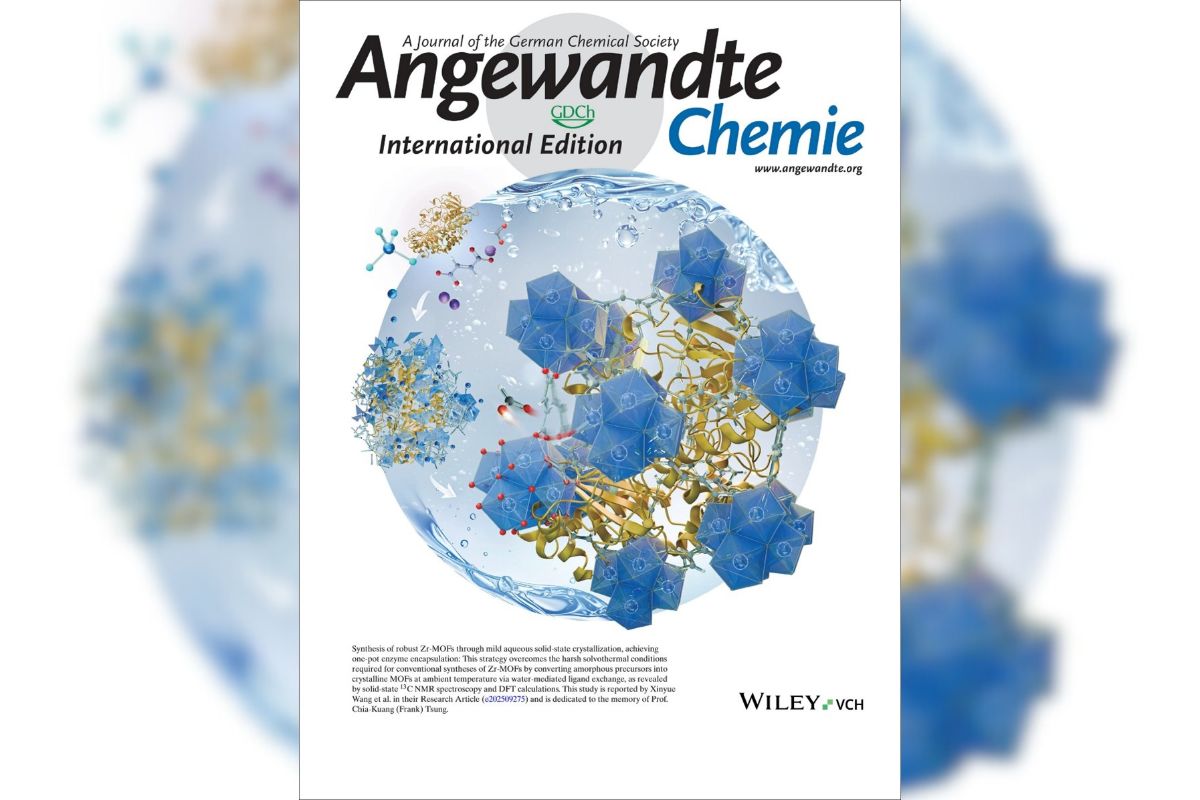
化學系謝發坤教授團隊研究成果登上化學旗艦期刊《Angewandte Chemie- 德國應用化學》封面。謝發坤教授提供
Figure:Research by Professor Shieh Fa-Kuen's group (Department of Chemistry, NCU) featured on the cover of Angewandte Chemie. Photo courtesy of Prof. Shieh. |
中央大學化學系謝發坤教授團隊開創「水相固相結晶」(SSC)策略,能在接近常溫常壓的水溶液中,像玩分子樂高般組裝出堅固的鋯「金屬有機骨架」(MOFs),並同步將酵素安全封裝,實現了「溫和製程中封裝活性生物分子」的目標,研究成果登上化學旗艦期刊《Angewandte Chemie- 德國應用化學》封面。此工作並獻給2021年不幸因新冠過世的波士頓學院台籍學者宗家洸教授,表彰他帶領台灣BioMOF團隊的貢獻。
2025年諾貝爾化學獎頒給日本、美國、澳洲的三位科學家,表彰他們發明「金屬有機骨架」(MOFs)材料。這種結構規則的「奈米海綿」,擁有無數整齊孔洞,科學家能像組裝樂高般設計其孔洞特性,使其在吸附溫室氣體、氣體分離與氫能儲存等綠能領域大展身手。儘管潛力無窮,MOFs在生物醫學的應用仍是一大挑戰。
謝發坤教授團隊研究獨步全球,開創「MOF 化學生物學」新領域。團隊早期開發出溫和的「一鍋合成法」,能在不破壞生物分子的情況下,將嬌貴的生物酵素完整包裹在 MOF 中,如同打造「奈米防護殼」的保護層,保護酵素在工業催化或藥物傳輸時的活性。然而,如何合成最為堅固的「鋯基 MOF」成為最大挑戰。傳統合成需要高溫與有機溶劑等,這些苛刻條件會破壞任何脆弱生物分子。為克服這項瓶頸,謝發坤教授攜手蔡惠旭教授與上海科技大學台灣籍卓聯洋教授,共同開創「水相固相結晶」(SSC)策略,成功破解難題。
這項技術能在接近常溫常壓的水溶液中組裝出堅固的鋯基MOF,並同步將酵素安全封裝。過往受限於嚴苛的合成條件,鋯基MOF材料蛋白質藥物傳輸領域的潛力始終未能充分發揮。此機制能將酵素、藥物或其他生物活性物質包覆於鋯基MOF中時,透過掌握包覆物表面的酸鹼性質,提高包覆的成功率和活性物質的穩定性。科學家如今能在常溫常壓的水溶液中,將酵素穩固包覆於堅韌的鋯基 MOF 中,如同為其打造專屬的防護殼。
此技術為生醫應用開闢新途徑,也使高效生物催化劑的製造邁向實用化。把材料組裝的「萬用鑰匙」,未來亦有潛力延伸應用於稀土回收等綠色科技領域,將臺灣的研發實力轉化為解決全球稀土供應困境的關鍵力量。
A research team led by Professor Shieh Fa-Kuen from the Department of Chemistry at National Central University has pioneered a solid-state crystallization in aqueous phase (SSC) strategy that enables the formation of robust zirconium-based metal–organic frameworks (MOFs) under near-ambient, water-based conditions. This breakthrough allows enzymes to be safely encapsulated during the crystallization process, achieving the long-standing goal of protecting active biomolecules under truly mild synthesis conditions. The team’s findings were selected as a cover story in the flagship chemistry journal Angewandte Chemie. Additionally, this work is dedicated to the memory of a dear friend, an outstanding collaborator of the BioMOF team in Taiwan, Prof. Chia-Kuang (Frank) Tsung, who passed away from COVID-19 in Boston on January 5, 2021.
Professor Shieh’s team pioneered a mild, one-pot, water-based synthesis that preserves enzyme activity for industrial catalysis and drug delivery. His group also established the field of MOF Chemical Biology, which focuses on encapsulating biomolecules within MOFs while maintaining their native function.
However, synthesizing highly stable zirconium-based MOFs had long been a major challenge. To overcome this obstacle, Professor Shieh collaborated with Professor Tsai Hui-Hsu and Professor Chou Lien-Yang of ShanghaiTech University, and together they developed the solid-state crystallization (SSC) strategy, successfully addressing this long-standing problem.
This technique enables the formation of durable zirconium-based MOFs in near-room-temperature aqueous solutions while firmly encapsulating enzymes within the tough MOF structure. It paves a new path for biomedical applications, advances the practical use of efficient biocatalysts, and offers promising potential for expansion into green-technology domains such as rare-earth recycling.